
Swarm Rooms
In this article, you'll learn how to set up Swarm Rooms in Enjo dedicated Slack or Teams channels that sync two-way with a support request, keeping all conversations and updates in one place.
Create dedicated channels in Slack or Teams that sync 2-way with a request.
How Swarm Rooms work
When a Swarm Room is created for a request, Enjo:
Posts all updates and activities from the request into the channel
Syncs all conversations in the channel back as comments on the request
Automatically adds any participants from the request as channel members
Before you start
You need Owner or Admin role in Enjo.
At least one ticketing system (e.g., Jira) must be connected to your workspace.
Slack or Microsoft Teams must be connected as a channel.
Set up Swarm Room triggers
Swarm Room triggers define the conditions under which Enjo automatically creates a new channel for a request.
Step 1 — Create a new trigger
Go to Automation Tools > Swarm Rooms > Triggers.
Click + New Trigger.
Step 2 — Configure the trigger
Enter the following details:
Trigger name — a unique name to identify this trigger
Ticketing system — select your connected ticketing app
Connection — select the account connection to use
Project — select the project to monitor
JQL — enter a JQL query to filter which issues trigger a Swarm Room
Condition — define when the Swarm Room should be created:
New ticket is created
Ticket field is updated — if you select this condition, choose the specific field to monitor
Platform — select Slack or Microsoft Teams
Workspace — select the workspace where the channel will be created
Step 3 — Configure the channel name
By default, the channel name uses the syntax @@@jira_issue_key@@@ — for example, ITSM-32.
To customise the channel name:
Click Show channel name syntax.
Copy your preferred syntax.
Paste it into the channel name field.
To make the channel private, check the Make channel private checkbox.
Step 4 — Save the trigger
Click Save to activate the trigger.
💡 You can create multiple triggers with different conditions, projects, or JQL filters to handle different types of requests with separate Swarm Rooms.
Configure Swarm Room settings
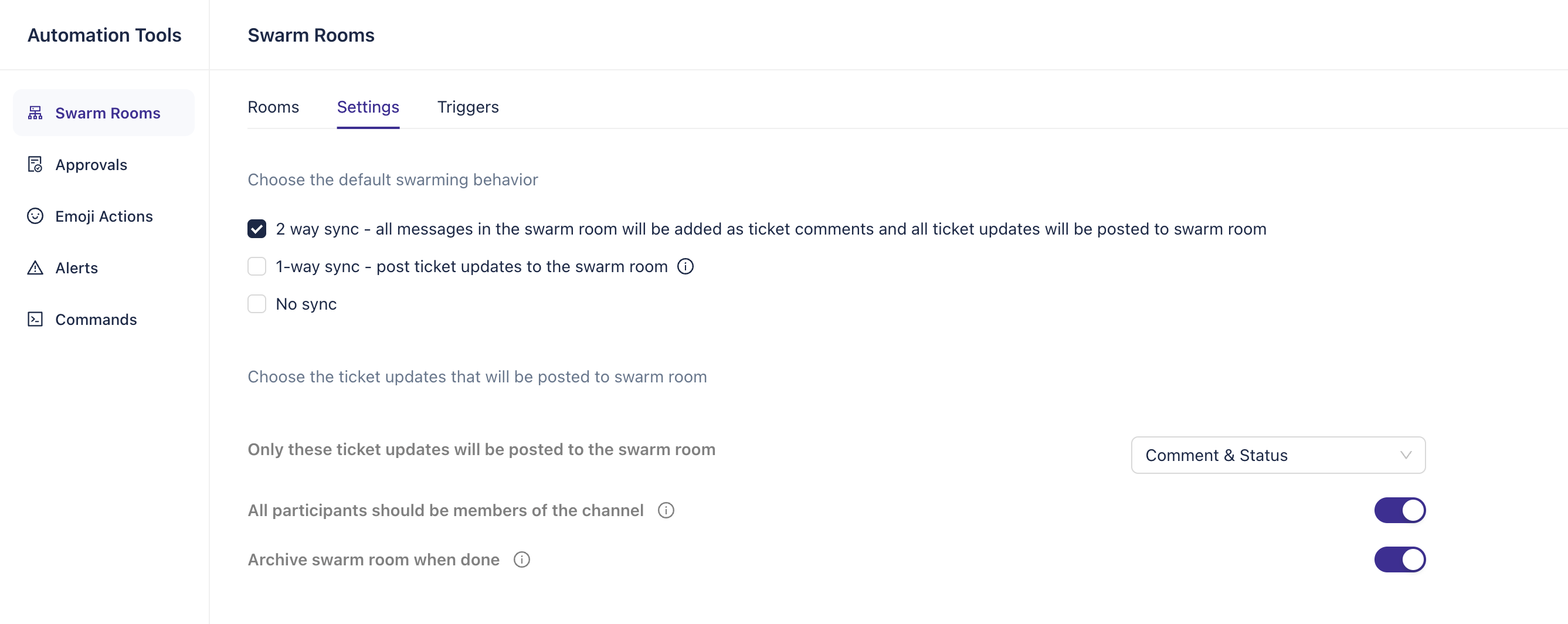
Go to Automation Tools > Swarm Rooms > Settings to customise default Swarm Room behavior.
Sync mode — choose how updates flow between the request and the channel:
Two-way sync — updates flow in both directions between the channel and the request
One-way sync — ticket updates are posted to the channel but channel messages are not synced back
No sync — channel and request are not synced
Additional settings:
Choose which ticket updates are posted to the Swarm Room
Add all ticket participants as channel members automatically
Archive the Swarm Room automatically when the ticket is resolved
View active Swarm Rooms
Go to Automation Tools > Swarm Rooms > Rooms to view all active Swarm Rooms created by your configured triggers.
What's next
Commands — Trigger actions or create tickets via slash commands in Slack or Teams.
Approvals — Set up in-chat approval flows tied to tickets.
Emoji Actions — Trigger workflows by reacting to messages with emojis.
Alerts — Set up real-time or scheduled notifications for your team.