.png)
Enjo Answers
In this article, you'll learn how to create Enjo Answers Q&A pairs that form your AI Agent's internal knowledge base using either Question-Based or Topic-Based formats.
Before you start
You must be an Owner or Admin in your Enjo workspace
Your AI Agent must already be created
You understand the difference between Question-Based and Topic-Based answers (see How it works section)
Allow 5–10 minutes per answer
How it works
Enjo Answers is your AI Agent's internal knowledge base. Every Q&A pair you create becomes a potential response when a user asks your AI Agent a question. Enjo Answers are distinct from:
Help Center — Public-facing self-service portal for customers
Knowledge Sources — External indexed content (Confluence, SharePoint, Google Drive, etc.)
You create Enjo Answers in two formats:
Question-Based Answer
A direct response to a specific question. Best for frequently asked questions with clear, concise answers.
Use when: The question and answer are straightforward ("How do I reset my password?")
Example answer: "Visit the password reset page at company.com/reset"
Typical length: 1–3 sentences
Topic-Based Answer
A comprehensive overview of a topic that may address multiple related questions. Best for complex topics with nuance.
Use when: The topic requires context or has multiple related questions ("What is our remote work policy?")
Example answer: Explanation of work-from-home guidelines, equipment provided, approval process, etc.
Typical length: 1–3 paragraphs
Both formats support question variations — alternative phrasings that trigger the same answer. When a user asks "How do I reset my password?" or "I forgot my password," the same answer appears.
ℹ️ Note: Your AI Agent searches Enjo Answers first when responding. If no match is found, it will trigger AI Actions or escalate to human support.
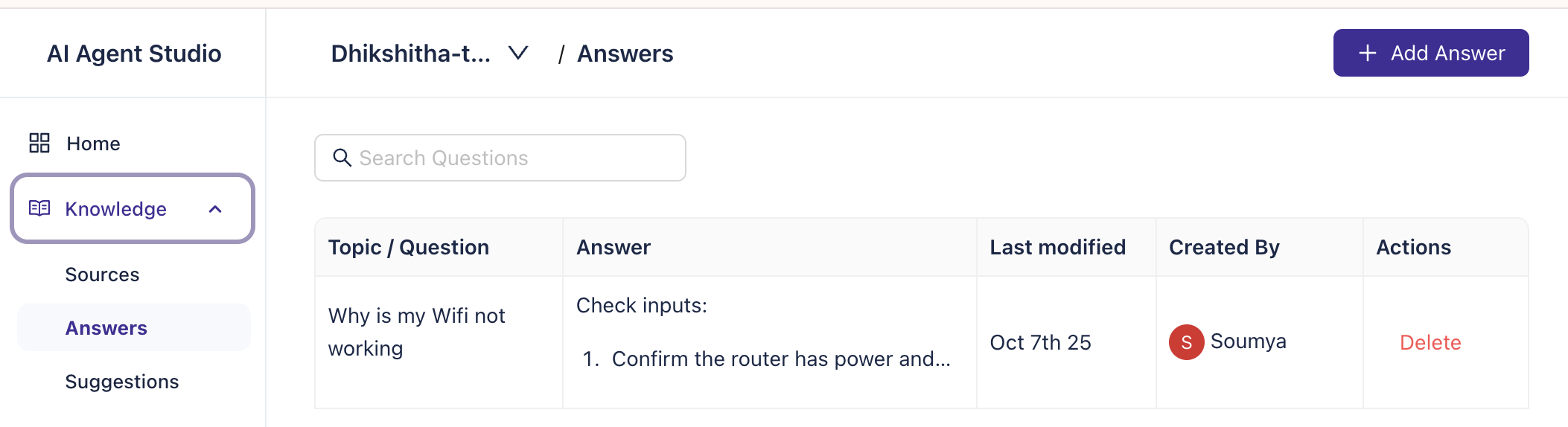
Access Enjo Answers
From the left panel, click Knowledge > Answers. The Enjo Answers page opens and displays all existing Q&A pairs.
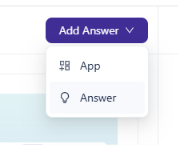
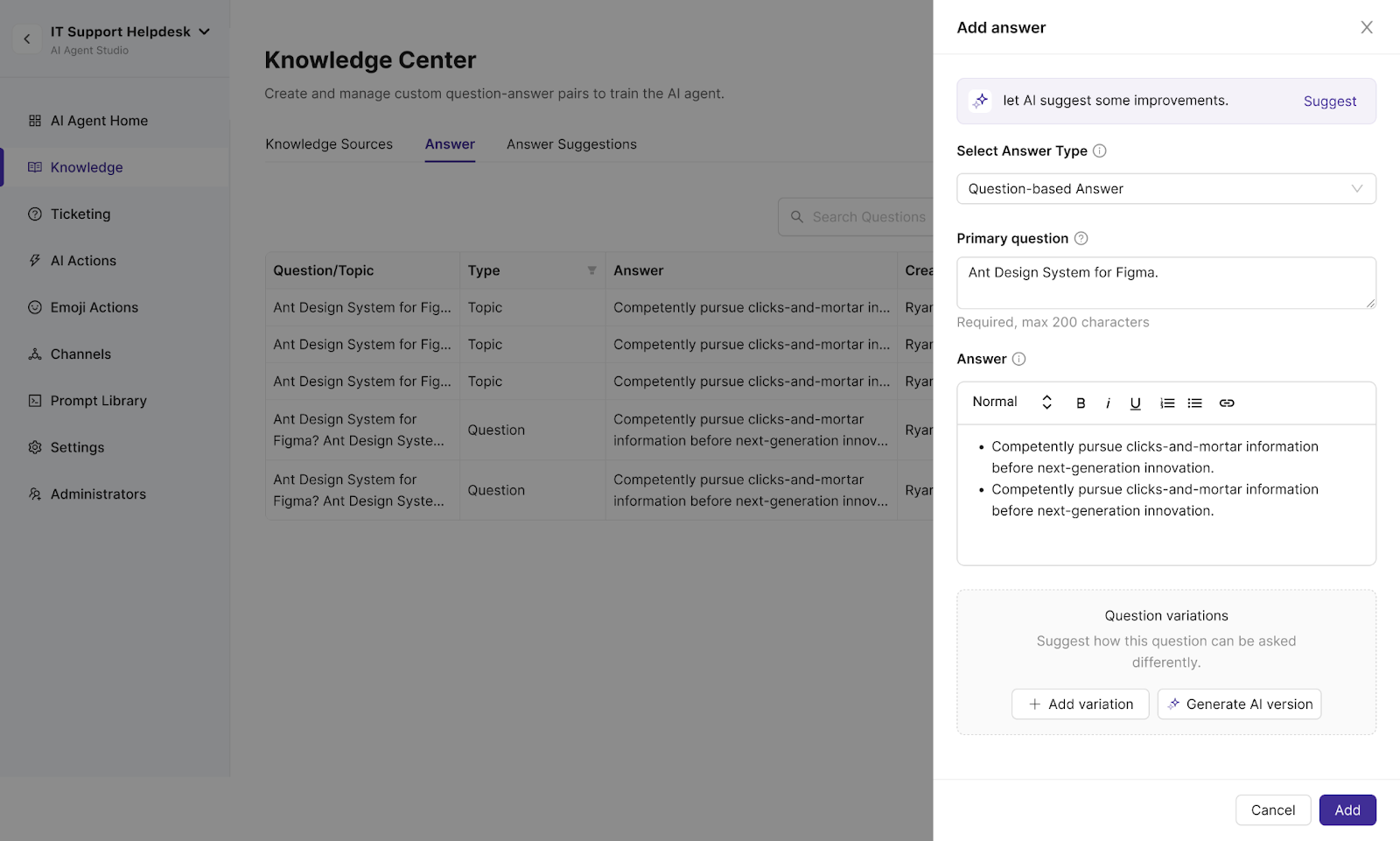
Click on Add Answer > Answer. The answer creation form opens.
Create a Question-Based Answer
Use Question-Based answers for straightforward Q&A pairs with specific questions and direct responses.
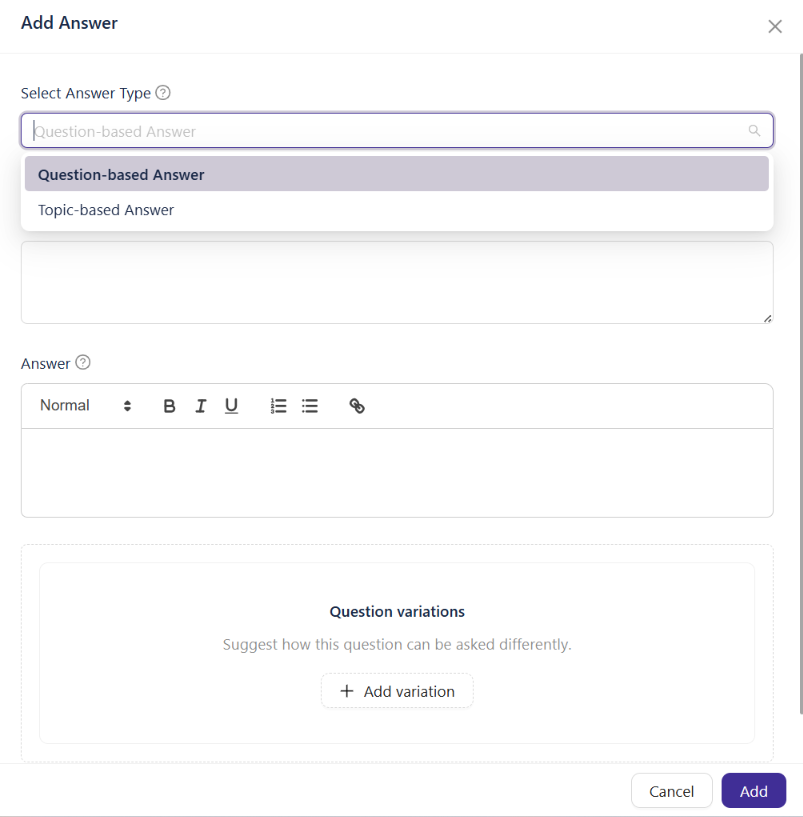
Select Question-Based from the answer type dropdown. The form updates to show fields for Question-Based answers.
Enter a Primary Question. This is the main question your answer addresses. Use clear, concise language (e.g., "How do I reset my password?" or "What is the onboarding timeline for new employees?").
Write your Answer. Provide a direct, helpful response. Keep it concise — aim for 1–3 sentences for straightforward topics. Use formatting (bold, lists, links) to improve readability.
Add Question Variations. Click + Add Variation and enter alternative phrasings that should trigger this answer. Examples for "How do I reset my password?":
"I forgot my password"
"Password reset"
"Change my password"
Aim for 3–5 realistic variations that reflect how users actually ask the question.
Click Add or Save. The answer is saved to your Enjo Answers knowledge base.
Create a Topic-Based Answer
Use Topic-Based answers for complex topics that require explanation, context, or address multiple related questions.
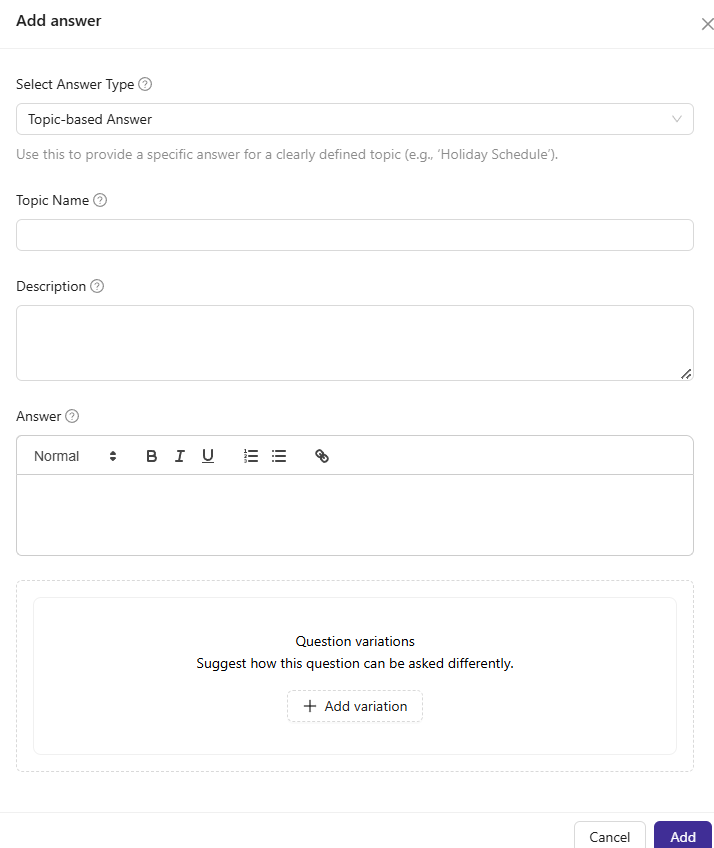
Select Topic-Based from the answer type dropdown. The form updates to show fields for Topic-Based answers.
Enter a Topic Name. This is the subject your answer covers (e.g., "Remote Work Policy," "PTO Guidelines," "IT Account Setup"). Use a name that:
Clearly describes the topic
Matches how users think about the subject
Avoids jargon when possible
Enter a Topic Description (optional). Provide a brief explanation of what the topic covers (e.g., "Guidelines for working from home, equipment, scheduling, and manager approval"). This helps your team understand the answer's scope.
Write your Answer. Provide a comprehensive explanation. Topic-based answers can be longer — typically 1–3 paragraphs or a structured format (bullet points, numbered lists, sections). Example for "Remote Work Policy":
Eligibility requirements
Approval process and timeline
Equipment and stipends
Expected availability
Communication expectations
Add Question Variations. Click + Add Variation and enter questions that should trigger this topic answer. Examples for "Remote Work Policy":
"Can I work from home?"
"What is the work-from-home policy?"
"Do I need approval to work remotely?"
"Remote work eligibility"
Aim for 3–5 realistic variations.
Click Add or Save. The answer is saved to your Enjo Answers knowledge base.
Understanding Answer Resolution Order
Your AI Agent resolves questions in a specific order within Enjo Answers:
Question-Based Answers search — The AI Agent uses semantic search to find matching Question-Based Answers by understanding question intent and variations.
Topic-Based Answers fallback — If no confident match is found in Question-Based Answers, the AI Agent falls back to Topic-Based Answers for broader coverage.
AI Actions or escalation — If no match is found in either Enjo Answers type, the AI Agent will trigger AI Actions (like system integrations) or escalate to human support.
This two-step approach within Enjo Answers ensures users get precise answers when available and broader topic coverage when specific questions aren't trained yet.
Example: A user asks "Can I work from home?" The AI Agent searches Question-Based Answers. If no match is found, it falls back to the "Remote Work Policy" Topic-Based Answer for a comprehensive response.
Test Your Answer
Before relying on your answer in live channels, test it to verify the AI Agent matches user questions correctly and returns the right response.
Click Playground to open the testing environment. Playground is a sandbox where you can test your AI Agent without affecting live conversations.
Ask a question matching your primary question or one of your variations. Example: If you created an answer for "How do I reset my password?", ask that exact question or one of your variations: "I forgot my password" or "Password reset."
Verify the response:
Does the AI Agent return your answer?
Is the source labeled "Enjo Answers"?
Is the answer accurate and helpful?
If the answer doesn't appear or needs refinement:
Edit the answer: Go back to Enjo Answers, find the answer, click to edit, and update fields
Refine question variations if the answer isn't matching user questions
Test again until you're satisfied
💡 Tip: Test multiple question variations to ensure they all trigger the correct answer.
Use AI Helper to Improve Your Answers
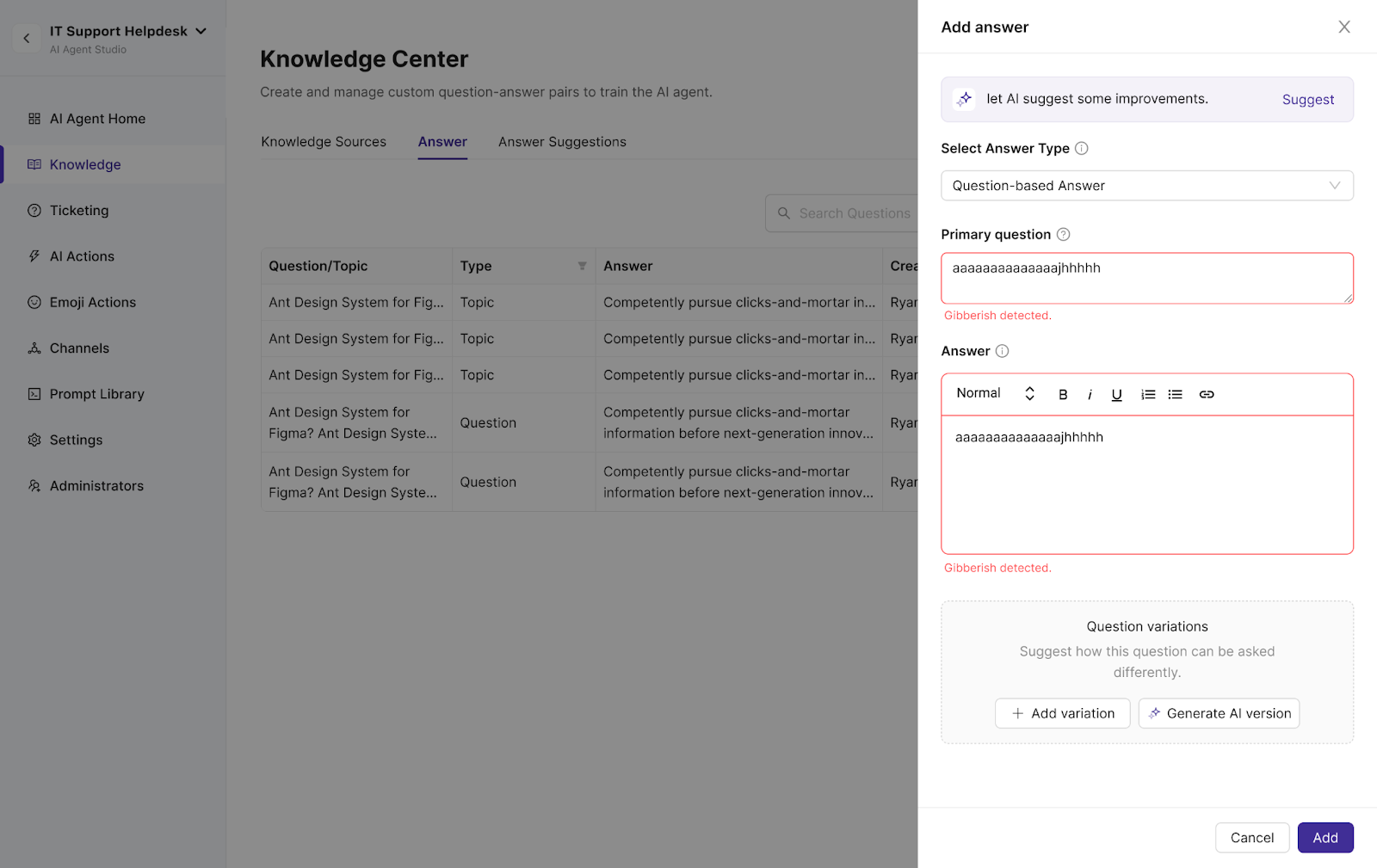
Enjo includes an AI Helper tool that automatically improves your questions and answers, making them clearer, more professional, and more concise. It can also generate alternative question variations to expand coverage.
Rewrite Questions and Answers
Use the "Rewrite Using AI" feature to enhance language clarity and professionalism.
Go to Add Answer or Edit Answer in your Enjo Answers section.
Fill in your primary question and answer content.
Click Rewrite Using AI. A preview panel appears showing AI-suggested improvements.
Review the suggestions:
Clearer phrasing
More professional tone
Concise language
Better formatting
Click Apply and Add to accept the improvements and save your answer.
ℹ️ Note: If your question or answer is unclear or incomplete, the AI Helper will show a warning message suggesting you revise your content before applying improvements.
Generate Question Variations
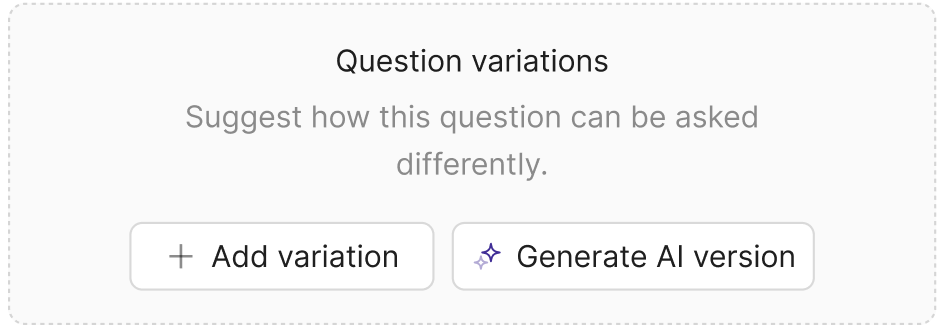
Use the "Generate Question Variations" feature to automatically create alternative phrasings for your primary question.
Go to Add Answer or Edit Answer in your Enjo Answers section.
Enter your primary question.
Click Generate Question Variations. The AI Helper generates up to three alternative question suggestions based on your primary question.
Review the suggested variations.
Add the variations you want to your answer by clicking Add next to each variation. You can edit suggested variations before adding them if you want to customize the phrasing.
💡 Tip: AI-generated variations are a starting point. You can combine AI suggestions with your own variations based on real user questions from Insights data or support tickets.
Edit or Delete Answers
To modify an existing answer:
Go to AI Agents > [Your Agent Name] > Enjo Answers.
Find the answer in the list and click it to open the edit form.
Update any fields (primary question, answer, variations, topic name, etc.).
Click Save or Update.
To delete an answer:
Go to AI Agents > [Your Agent Name] > Enjo Answers.
Find the answer and click the menu (…) or Remove option.
Confirm deletion.
⚠️ Warning: Deleting an answer removes it from your knowledge base immediately. Users will no longer receive that answer if they ask related questions.
Enable User Suggestions and Improve Answers Collaboratively
Users can suggest improvements to your Enjo Answers directly through the "Improve Answer" button. This allows your team to gather feedback and refine answers based on real user interactions.
How User Suggestions Work
When users interact with your AI Agent and receive an answer, they can:
Rate the answer's helpfulness
Click Improve Answer to suggest edits or clarifications
Their suggestions appear in the Answer Suggestions tab where admins can review, edit, approve, or decline them.
Review and Approve Answer Suggestions
As an admin, you can manage user-suggested improvements to ensure answer quality.
Go to AI Agents > [Your Agent Name] > Enjo Answers.
Click the Answer Suggestions tab. This tab displays all pending suggestions from users.
For each suggestion, review:
The original answer
The suggested improvement
The user's context or reason for the suggestion
Choose an action:
Approve — The suggestion is applied to your answer and integrated into Enjo Answers knowledge base immediately
Decline — The suggestion is rejected; users will not see the edit
Edit & Approve — You can modify the suggestion before approving it
Once approved, the updated answer becomes available to your AI Agent for future queries.
ℹ️ This collaborative workflow allows your team and users to continuously improve answer quality without requiring admins to manually discover gaps or outdated content.
Best practices
Start small — Create 5–10 high-priority answers first (most common questions), then expand based on user feedback and Insights data
Use realistic variations — Add questions the way users actually ask them, not how you think they should ask
Test thoroughly — Always test new answers in Playground before deploying to live channels
Keep answers current — Review and update Enjo Answers quarterly to reflect policy changes, new procedures, or feedback
Balance depth — Question-Based answers should be concise (1–3 sentences); Topic-Based answers can be longer but should stay focused
Use formatting — Bold key points, use bullet lists, and add links to improve answer clarity and scannability
Monitor performance — Check Insights to see which questions trigger your answers and if users find them helpful
Avoid duplication — Review existing answers before creating new ones; consider adding variations instead of duplicating content
Why this matters
Enjo Answers form the foundation of your AI Agent's knowledge. Well-structured, accurate Q&A pairs improve resolution rates, reduce escalations, and ensure users get fast, consistent answers without human intervention. By training your AI Agent with comprehensive Enjo Answers, you maximize self-service deflection and team efficiency.
What's next
Train Your AI Agent on Conversations — Create Enjo Answers directly from real user conversations
AI Agent Performance Insights — Track which questions are resolved and which need new answers
Knowledge Sources — Connect external documents (Confluence, SharePoint, Google Drive) as supplementary knowledge